
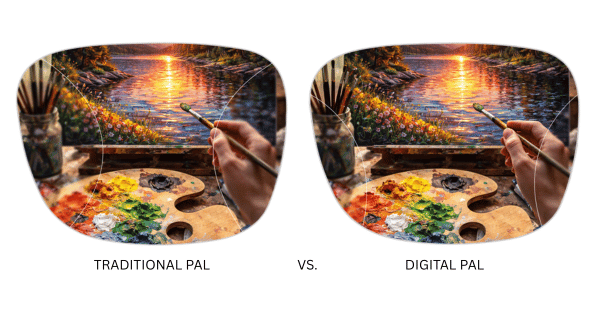
At IcareLabs, we believe progressive lenses are only as good as the design, processing, and real-world compensation behind them.
As Eye Care Professionals (ECPs), you already know patients tend to focus on brand names and price. But the true difference in progressive lens performance comes down to how the optics are engineered — and whether they’re optimized for how the frame is actually worn.Understanding the difference between traditional progressive lenses and digital free-form progressive lenses allows you to:
- Reduce non-adapts
- Decrease costly remakes
- Improve patient satisfaction
- Confidently recommend premium lens solutions
Let’s break it down.
Traditional Progressive Lenses: Standardized Optics
Traditional progressive lenses are produced using molded or cast front-surface designs. These lenses are manufactured in volume, meaning every wearer receives the same progressive layout — regardless of frame selection or individual wearing position.
Where Traditional Progressives Work Well
- Straightforward prescriptions
- Conservative frame selections
- Budget-conscious patients
- Backup or occupational eyewear
For certain scenarios, they still serve a purpose.
Where Traditional Progressives Fall Short
Traditional progressives assume:
- Neutral frame wrap
- Average pantoscopic tilt
- Standard vertex distance
But in real-world dispensing, very few frames sit in this “average” position.
When these variables aren’t compensated for, unwanted aberrations increase — leading to distortion complaints, swim sensation, and adaptation challenges.
Digital Progressive Lenses: Designed for Real-World Wear
Digital progressive lenses (also known as free-form progressive lenses) are surfaced point-by-point using advanced digital technology. This allows the lens design to be mathematically optimized for each wearer.
For ECPs, this is where control and consistency improve dramatically.
Progressive Lens Compensation: The Optician’s Advantage
Every adjustment you make to a frame changes how light travels through the lens.
- Pantoscopic tilt
- Frame wrap (face form)
- Vertex distance
- Prescription power
All introduce optical changes.
Without compensation, these changes create unwanted error.
With digital progressive lens compensation, the optics are recalculated based on how the frame actually sits on the patient’s face — not how it sits in theory.
At IcareLabs, we believe this is one of the most important advancements in modern lens processing.
Instead of dispensing lenses designed for averages, you’re delivering custom progressive lenses optimized for real-world performance.
Why Digital Progressive Lenses Reduce Remakes & Non-Adapts
1. More Usable Optics
Digitally surfaced lenses provide:
- Wider clear zones
- Smoother transitions
- Improved peripheral clarity
Patients don’t have to “hunt” for vision.
2. Faster Adaptation
Reduced distortion means:
- Fewer balance complaints
- Less swim sensation

- Easier adaptation for first-time progressive wearers
For ECPs, that translates to fewer troubleshooting appointments.
3. Better Performance in Complex Prescriptions
High minus, high plus, and astigmatic prescriptions benefit significantly from free-form digital surfacing — especially in larger B measurements or mildly wrapped frames.
4. Greater Frame Flexibility
Digital lenses allow you to confidently dispense:
- Fashion-forward frames
- Larger eye sizes
- Mild wrap designs
without sacrificing optical performance.
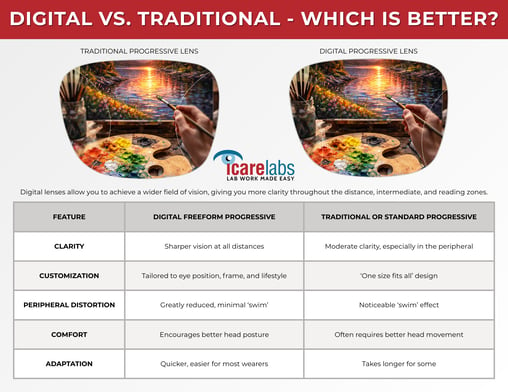
Traditional vs. Digital Progressive Lenses: A Dispensing Comparison
| Dispensing Factor | Traditional Progressive | Digital Progressive |
|---|---|---|
| Lens Design | Fixed | Customizable |
| Frame Compensation | None | Full |
| Peripheral Clarity | Acceptable | Enhanced |
| Adaptation Rate | Average | Faster |
| Remake Risk | Higher | Lower |
| Optician Control | Limited | High |
How to Position Digital Progressive Lenses to Patients
You don’t need to explain surfacing paths or algorithms.
Simple, clear language works best:
“Traditional lenses are made for the average person. Digital lenses are made for how your glasses sit on you.”
Or:
“We measure and adjust your frame so the lens is customized to how you actually wear it.”
This frames the upgrade as precision and personalization, not luxury.
The IcareLabs Approach: Supporting Independent ECPs
At IcareLabs, we partner with independent practices and optical retailers to provide:
- High-quality digital progressive lenses
- Advanced free-form surfacing
- Reliable turnaround times
- Responsive lab support
- Lens solutions designed to reduce remakes
Our goal is simple: help you deliver better outcomes with fewer headaches.
Because when lenses are designed for real-world wear — not theoretical averages — everyone wins.
Looking to Improve Progressive Adaptation Rates?
If you’re evaluating your current wholesale optical lab or looking to improve progressive lens performance, digital compensation can make a measurable difference in patient satisfaction and practice profitability.
Better optics. Fewer remakes. Stronger patient trust.
That’s the difference customization makes.
