

Progressive lens technology has come a long way over the past decade. Today’s premium progressive lenses are no longer based on a one‑size‑fits‑all template. Gone are the days of slump molded, front surface design, one size fits all progressives.
Whether you are working with branded designs such as Varilux® XR® and Shamir® Autograph Intelligence® or our house-brand Heritage Ultimate or Legacy G3 Ultimate, you can expect modern premium PALs to include compensation technology.
Why Compensation is Important
When a patient goes through an eye exam, the phoropter holds the test lenses perfectly straight and at a set distance from their eyes. With real frames, the lenses often sit at an angle, curve across their face and have a different vertex distance than the phoropter.
These physical variables change how the light bends and how your patient's brain perceives the prescription. Compensation corrects these real-word changes by recalculating the Rx and utilizing advanced digital surfacing equipment to process. Through complex mathematic calculation, compensation alters the power in the lens so your patient can experience the exact same visual clarity with their new lenses as they had in the exam room.
What Is Taken into Account?
Traditional progressive lenses are designed as if every lens sits in a “standard” position in front of the eye. In reality, every patient wears their glasses a little differently. Factors such as:
-
Face form wrap
-
Vertex distance
-
Frame size and shape
-
Pupillary measurements
-
Base curve and backside curve
All of the above affect how light enters the eye. Modern compensated progressives factor in these real-world wearing conditions. During the design process, software predicts how the lens will perform on the patient’s face, then adjusts the prescription power and progressive design to match; improving the accuracy of the compensation.
If these measurements are not provided, our system will use the information we do have—such as base curve, frame size and general shape, and backside curve for uncut jobs—to create the best possible design. For finished jobs, we will also incorporate the measured face form wrap. In cases where data like vertex distance and pantoscopic tilt are not supplied, those values will be intelligently estimated so the lens can still be optimized for your patient.
You can think of it as tailoring a suit or dress instead of buying one off the rack. The lens is customized to how the patient actually wears their eyewear, not just how it measures on a lab bench.
Benefits for the Wearer
-
Wider, More Comfortable Vision
Compensation technology helps minimize unwanted astigmatism and distortion in the periphery. Patients typically enjoy wider, more usable viewing zones at distance, intermediate, and near.
-
Improved Clarity in Real Wearing Conditions
Because the lens is optimized for the way the frame sits on the face, vision stays clearer and more stable during everyday wear.
-
Easier Adaptation
A major advantage is smoother, more natural adaptation. Patients often report less head movement, less awareness of peripheral blur, and an overall more relaxed visual experience.
-
Better Performance in Higher Prescriptions
Patients with higher prescriptions usually see the greatest benefit from compensation technology, since even small changes in lens position can have a big impact on visual performance.
What is Different?
Because compensation technology fine‑tunes the lens to improve on-eye performance, the measured power may not always match the original written prescription exactly when you verify it in a traditional way on the lensometer. The software has already taken into account factors such as pantoscopic tilt, face form wrap, vertex distance, and base curve to “pre-adjust” the power so that, once the lens is worn, the eye receives the intended prescription at the correct point in space.
Compensation actually corrects to the prescribed Rx by taking into account the angle that light is entering the lens in hundreds of points. Unwanted astigmatism is largely reduced through compensation.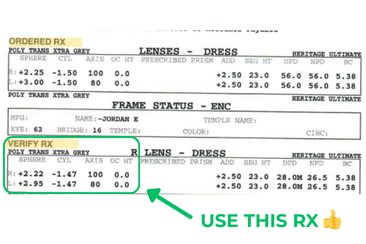
As a result, what you see at the verification point is a compensated value rather than a simple copy of the ordered Rx. Small shifts in sphere, cylinder, or axis are expected and are part of the design, not a defect. Within the manufacturer’s stated tolerances, this difference does not mean the lens is wrong; it means the lens has been optimized for real-world wearing conditions to deliver the most accurate vision to your patient.
Your invoice from IcareLabs will show both the ordered Rx values and the Verify Rx Values. Utilize the verify Rx values to check the lenses in.
Best Practices for Verification
-
Locate and verify the permanent reference markings.
-
Position the fitting cross and reference points correctly in the lensometer.
-
Measure according to the manufacturer’s verification guidelines.
-
Use the Verify Rx values as your primary verification reference.
-
Compare lensometer readings to the compensated values listed on the invoice.
-
Keep in mind that these values may differ slightly from the doctor’s original prescription.
-
If your measurements match the Verify Rx information, the lenses have been manufactured correctly according to the compensated design.
Using the Verify Rx data helps remove uncertainty and supports confidence when you are dispensing today’s advanced progressive lenses.
Key Information to Share With Patients
When you deliver compensated progressive lenses, a few simple talking points can go a long way toward patient confidence and successful wear. Let them know that they are getting the latest and greatest in lens design and technology.
-
“Your lenses were customized specifically for how this frame fits your face.”
-
“The design is optimized to give you wider, more natural vision at all distances.”
-
“You may still notice minor changes in how you move your head and eyes for the first few days—that is normal.”
-
“Wearing your new lenses consistently is the quickest way to adapt.”
-
“If anything feels off during the adaptation period, please come back for an adjustment before assuming the prescription is not right.”
Patients appreciate knowing that their lenses are not just made to a prescription, but are tailored to their individual frame fit and prescription.
Final Thoughts
Modern compensated progressive lenses are one of the most meaningful advances in lens technology. By accounting for real-world frame positioning and individual wearing parameters, they can provide clearer vision, wider visual fields, and a more comfortable overall experience for your patients.
For you, the ECP, understanding how compensation works—and how to verify these lenses using the Verify Rx information from IcareLabs—supports accurate dispensing and stronger patient trust. When patients understand the personalized technology behind their lenses, they are more likely to recognize the value of premium designs and enjoy long-term success with their eyewear.
